a short poem by g.f marlier, and a long poem by Amiri Baraka/ on jesus
I detest the Episcopal Church It is the Catholic Church with the desperate proletariat removed Selfless love is a quality of peasants and slaves, of those who have nothing but a soul to lose or gain. and I tell you there is nothing bourgeois nothing properly Anglican in the life and passion death and resurrection of Christ
*************************************************************************************
When We’ll worship Jesus
Amiri Baraka
We’ll worship jesus
When jesus do
Somethin
When jesus blow up
the white house
or blast nixon down
when jesus turn out congress
or bust general motors to
yard bird motors
jesus we’ll worship jesus
when jesus get down
when jesus get out his yellow lincoln
w/the built in cross stain glass
window & box w/black peoples
enemies we’ll worship jesus when
he get bad enough to at least scare
somebody—cops not afraid
of jesus
pushers not afraid
of jesus, capitalists racists
imperialists not afraid
of jesus shit they makin money
off jesus
we’ll worship jesus when mao
do, when toure does
when the cross replaces Nkrumah’s
star
Jesus need to hurt some a our
enemies, then we’ll check him
out, all that screaming and hollering
& wallering and moaning talkin bout
jesus, jesus, in a red
check velvet vine + 8 in. heels
jesus pinky finger
got a goose egg ruby
which actual bleeds
jesus at the apollo
doin splits and helpin
nixon trick niggers
jesus w/his one eyed self
tongue kissing johnny carson
up the behind
jesus need to be busted
jesus need to be thrown down and whipped
till something better happen
jesus ain’t did nothing for us
but kept us turned toward the
sky (him and his boy allah
too, need to be checkd
out!)
we’ll worship jesus
when he get a boat load of ak-47s
and some dynamite
and blow up abernathy robotin
for gulf
jesus need to be busted
we ain’t gonna worship nobody
but niggers getting up off
the ground
not gon worship jesus
unless he just a tricked up
nigger somebody named
outside his race
need to bust jesus (+ check
out his spooky brother
allah while you heavy
on the case
cause we ain gon worship jesus
we aint gon worship
jesus
we aint gon worship
jesus
not till he do somethin
not till he help us
not till the world get changed
and he ain, jesus ain, he cant change the world
we can change the world
we can struggle against the forces of backwardness, we can change the world
we can struggle against our selves, our slowness, our connection
with
the oppressor, the very cultural aggression which binds us to
our enemies
as their slaves.
we can change the world
we aint gonna worship jesus cause jesus dont exist
except in song and story except in ritual and dance, except in
slum stained
tears or trillion dollar opulence stretching back in history, the
history
of the oppression of the human mind
we worship the strength in us
we worship our selves
we worship the light in us
we worship the warmth in us
we worship the world
we worship the love in us
we worship our selves
we worship nature
we worship ourselves
we worship the life in us, and science, and knowledge, and
transformation
of the visible world
but we aint gonna worship no jesus
we aint gonna legitimize the witches and devils and spooks and
hobgoblins
the sensuous lies of the rulers to keep us chained to fantasy and
illusion
sing about life, not jesus
sing about revolution, not no jesus
stop singing about jesus,
sing about, creation, our creation, the life of the world and
fantastic
nature how we struggle to transform it, but don’t victimize our
selves by
distorting the world
stop moanin about jesus, stop sweatin and crying and stompin
and dyin for jesus
unless thats the name of the army we building to force the land
finally to
change hands. And lets not call that jesus, get a quick
consensus, on that,
lets damn sure not call that black fire muscle
no invisible psychic dungeon
no gentle vision strait jacket, lets call that peoples army, or
wapenduzi or
simba
wachanga, but we not gon call it jesus, and not gon worship
jesus, throw
jesus out yr mind. Build the new world out of reality, and new
vision
we come to find out what there is of the world
to understand what there is here in the world!
to visualize change, and force it.
we worship revolution
bonheur, malheur
Happiness. In french, bonheur: the good hour, as opposed to unhappiness, malheur: the bad or evil hour. Where were you standing when the hours were sorted? There aren’t enough good hours, and we all must settle for a greater or lesser lot of the bad ones. There may be an hour within which you exchange wedding vows, an hour within which you choose a vocation, uproot yourself, or speak truth upon uncertain ground to an unreliable listener. There is the hour of your birth and above all the hour of your death. You may hope for these to be among the good hours, but nothing is guaranteed.
****************************************************
Down in the shallow trenches of my erudition
palms upon the stones I searched-
for what?
For shelter, for a route out, beyond, no,
Yes-
deeper within.
With humble inherited pick
and shovel. With all but my grip
on the tools unsure-
I dug at a pulse I sensed
in the center
of the Earth
where the roots
of continents converge.
+++++++
sorting pages, smelling September again…
Where there once was an abstract landscape crossed by quietude, nostalgia, perhaps insufficiently sophisticated but deeply personal ideas poetic loneliness in doorways, chips in curbstones leaking words visions of the Virgin over floodlit parking lots now there are photos of favorite writers- Didion, Colette, Baldwin, Lorca- taped up on the wall. Insecurities and petty bloodless blood-feuds of a smattering of Others float, glowing particles, in a neutral pool of days I must traverse.
*******************************************************
« I have lived in equatorial America since 1935 and only twice had fever. I am an anthropologist who lost faith in her own method, who stopped believing that observable activity defined Anthropos. I studied under Kroeber at California and worked with Lévi-Strauss at São Paulo, classified several societies, catalogued their rites and attitudes on occasions of birth, copulation, initiation , and death, did extensive and well-regarded studies on the rearing of female children in the Matto Grasso and along certain tributaries of the Rio Xingu, and still I did not know why any one of these female children did or did not do anything at all. Let me go further. I did not know why I did or did not do anything at all. »
-Joan Didion, from the book of common prayer
« What I am trying to conceptualize with the help of the philosopher is that which I have already intuited » -Charles Simic
« The poet of the Kosovo cycle rebels against the very idea of historical triumph. Defeat, he appears to be saying, is wiser than victory. the great anti-heroes of these poems experience a moment of tragic consciousness. they see the alternatives with all their moral consequences. They are free to make a fateful choice. They make it with full understanding of its consequences. For the folk poet of these poems, true nobility and heroism comes from the consciousness of the Difficult Choice. »
-Simic
****************************************************************
Finger-worn and foot-buffed steel and linoleum. Deep knowledge of the insides of occupational objects….
I see the Paysage of my near-decade of choices it seems a system of baked ochre and orange canyons, entered almost by accident. A place of occasional tedium, doubt, self-doubt, where thirst has sometimes summoned a feeble, ice-cold spring. Twice while wandering up the side-cuts I stumbled on a hanging garden so extraordinary, Edenic, revelatory, that I cried out. I’ve learned to smell and listen, to observe and follow wiser, smaller creatures. I received a proffered word: Survival. I picked out a trail when there wasn’t one, and it took me years- seven and a half, to be exact- but I made it to the deepest point, a descent of many fathoms. I drank my fill from a wide and swiftly running river and then I rode it out.
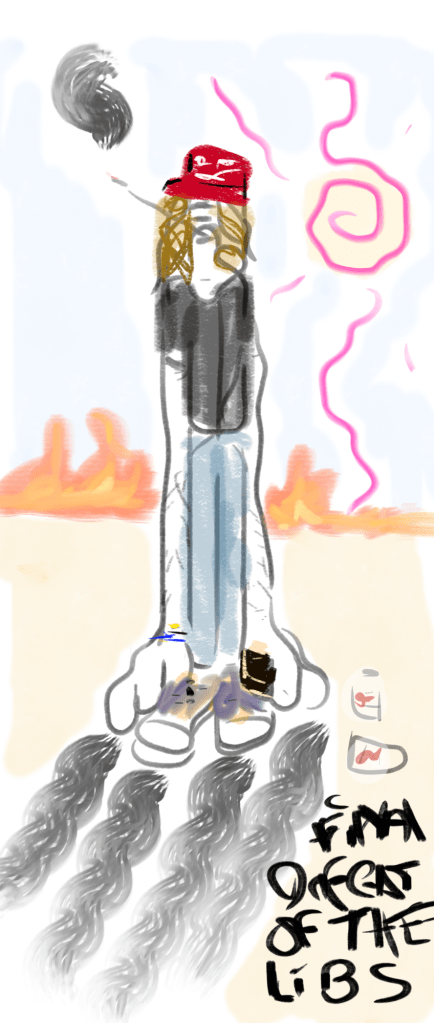
*Drawing by G.F Marlier (the old College Ave. Safeway, right before they tore it down)
Cheat Lake ’93
The plastic basins sit in the sink. I would say « kitchen sink » but there is only one sink, spring-fed, in the cabin my father and uncle built with their friends on the first backwater of the Cheat Lake in West Virginia almost 50 years ago. The basins are now used to soak crusted egg off the white plastic plates with their pea green and yellow floral design. The plates, like the colored glass lamp hanging over the table and the embroidery of mushrooms on the wall, are relics of 70’s beer and cigarette bacchanals, before us kids, when the place was still called « Mecca South ».
The basins, however, date from the early 90’s, and before they were used to soak breakfast dishes they were used to collect my father’s excess bodily fluids, mostly bloody phlegm, as I recall, brought up by long bouts of a painful, hacking cough.
They came from Ruby Memorial Hospital, and are still, 24 years later, the easily identifiable (at least to anyone who has spent a lot of time in hospitals) hospital pink that they were in 1993. My memory of my father’s facial features has faded more- much more- than the color of these plastic basins.
The pink is very tasteful, actually, which surprises me when I go back to the family place once every year or two and re-discover them. One of my aunts built a house on the property and lives there year-round now, and the past few years my cousins have been bringing their small children for impromptu family reunions. I always find the basins still here and notice again that the pink is not a bubble-gum pepto-bismol pink but rather a dusky, purplish-pink, somewhere between blush and bruise.
That summer, the summer of ’93, my father was hospitalized for a month (or a little more? or a little less?) with a septic knee infection (I think this is what it was? All I really knew at the time was that the knee was the size of a grapefruit, and it was very serious). My older brother was in Mexico visiting Aunt Julie and Tio José, and my mother, panicked and doing a less expert job of hiding it than she generally did, mostly stayed at the hospital. That left me largely at the cabin with a dumb Brittany Spaniel named Calvin and a field mouse-obsessed orange tabby tomcat named Popcorn, listening to the same mixtape cassette (Duran Duran, U2, SWV), or top 40 country music on the radio, eating toasted and buttered english muffins when I got hungry. I also learned how to meditate by following the instructions in a worn paperback called « Yoga Meditation » which I had purchased at the used bookstore in Morgantown. The cover had a photo of a lady in a white leotard with long blonde hair sitting in lotus position with a tall candlestick burning in front of her.
I would walk the narrow path hacked into a ridge of the steep hillside, following the shoreline of the backwater below, until I got to what I had designated as my meditation spot; a boulder protruding out over the long drop to the lake, with a small, quiet stream running beside it. I would sit cross-legged, close my eyes most (but not all) of the way, count and concentrate on my in-breaths and out-breaths, and try to notice my thoughts as they came up and dismiss them, like blowing a soap bubble out towards the lake, watching it drift and pop. My favorite type of meditation was 360 degree listening meditation. I focused on individual sounds, and then gradually learned to notice them together, to be aware of the spontaneous symphonic qualities of sound. The stream running close by on my left, stillness as it fell over the ledge and the splash on the rocks below as it continued on it’s way down to the lake. Wind in the thick, bright green foliage all around me. A cricket somewhere behind me. a distant jet-ski’s roar and stop. An outboard motor idling as someone pulled into a shady fishing cove on the opposite bank. loud laughter from the Graziani’s dock, echoing over the backwater. The hum of a plane overhead. By the time I was back at the cabin, changed into my bathing suit, and wading, then diving into the cool, sun-dazzled green water of Cheat Lake, my mind was often nearly empty. It may not be an accurate recollection, but I do not recall feeling lonely or scared.
At some point, after maybe two weeks or so, Grandma came down from Pittsburgh to stay at the cabin with me. She brought white bread, chipped ham, mayo and iceburg lettuce. She brought milk and Frosted Flakes. She brought a semblance of normalcy, and a flurry of activity. To every day, it’s project. We hiked up to the bright, sunny pastures at the top of the property to pick blackberries. Grandma with a kerchief tied over her silver hair. We tried our hand at fishing from the dock. We collected firewood. We built a « handicapped ramp » up to the front porch of the cabin out of clay that I dug out of the lake by the bucketful and large flat stones that I dug up all up and down the shoreline, and hauled up the path in a little red Flyer wagon. Grandma explained that the ramp was because my father was going to get out of the hospital and come back here, but would have no flexibility in the knee, and would certainly be using a walker or a cane, if not a wheelchair. I see now that my grandmother conceived of this project as a way of occupying my time and distracting me, as a way of giving me some structure (little did she know I had done fine without it), and to give me Optimism writ large, as a concrete thing I could feel and hold, even build myself, one stone, one handful of wet clay at a time.
Optimism was sort of a moot point for me, though. It really did not seem conceivable to me that my father would die. When I was near him I was enormously, inarticulately concerned with his suffering. I felt his suffering physically, in my own knobby, twiggy wisp of an almost-pubescent body. But at that time his death, his inevitable death, for a full-blown AIDS patient in 1993 had virtually no hope of survival, simply was not real to me. His death belonged to the realm of impossible- I should say impermissible– things, and so did not concern and pre-occupy me as it has off and on in all the years since it did occur.
When Grandma drove down to West Virginia from Pittsburgh and hiked in to the cabin with groceries, straining to haul her petite body over fallen trees that blocked the path, she may have brought, tucked in with the groceries, a fashion magazine. I can’t remember, but it strikes me as likely, because both my mother and my grandmother bought me fashion magazines as a form of reward or comfort. My mother always gave me the hulking behemoth September issue of Harper’s Bazaar. Grandma may have brought me the July, or the new August Vogue.
Decades later, it is with the eyes of an aesthete, a now confirmed devotée of Fashion (studied at Parsons, apprenticed to a bespoke tailor, etcetera), as well as for many years a practicing visual artist (Junior year of college painting in a Paris Atelier, etcetera) that I see the darkish pink of these hospital spittoons in the sink. I think, « I would like a linen dress in that color. A cashmere tunic with big pockets and a scoop neck. Silk lounge pants. Suede high-top sneakers. »
I am well aware of what they are and how they came to be here. He did insist on leaving the hospital, despite the doctor’s warnings that it would kill him. As my mother never tires of reminding me, I get my stubborn, bullheaded streak, as well as my temper, from him. My father came back to the cabin on an old pontoon boat, ferried in by loyal, deeply good, gutter-talking, chain-smoking, large, loud-laughing mountain neighbors who had known him since he was a child and loved him. He used the ramp that Grandma and I had built. He was not well and I distinctly remember him, after having insisted on going out sailing and getting caught in a storm (that stubborn streak again- Death be not proud!), lying on the sofa under an electric blanket and a couple other blankets, shivering, irritable. I lay down beside him, put my arm and leg over him, and lay my head on his bony, caved-in chest, determined to give him whatever warmth I had.
We returned to Boston when the scent of Fall was on the air, just in time for the start of school. He survived for almost two more years after that summer; an incredible feat considering that he had no functioning immune system of his own at that point, only a sister who was a blood match, and who was willing to have white blood cells sucked out of her body and pumped into his body to buy him a little more time.
Sometimes I think any normal family would get rid of those pink plastic basins. But then I realize that « normal » doesn’t mean anything. There is no « normal family », just as there is no « normal person », no « normal life ».
castles like this
Fingernail pulled down the side of a bookshelf There isn’t enough time to tour the place My kind of people can’t feel at ease in castles like this and I don’t know where your kind of people feel at ease
the future
Remember the first time you opened your eyes inside an ocean wave?
Do you remember what dim expanse your eyes beheld in that moment, and how they smarted?
That was the future. The past, as well. You have seen all Time and known it.
But that was so long ago.
*painting by Cynthia Estep
for Marshall Mancuso (1980-2016)
In a blue-bell’s dewy center I spied your astral eye the child you- the one I never knew, but guessed at.
Dis-embodiment, one may have slurringly suggested – in your days of healing sculptures; quartz and copper hanging from the ceiling over prostrate forms of revelers in Drum+Bass nights of E and K and Xanax before Heroin –
« Dis-embodiment will free us, Death’s a friend, man- » the twin of birth and dark is day and shadow just a ray of sun you’ve stared too long at.
That last long-distance phone-call I stood in my kitchen and your voice came splintered and syrupy through the line saying you needed a ride to the other side of Boston to pick up a sculpture and you were lonely and you regret that we never slept together and all I could say was well I’m married so it will never happen now but I’m your friend Marshall I’m in California Marshall you’re supposed to be a healer, remember? Marshall there’s nothing I can do I’m 3000 miles away right now I’m 3000 miles away
I remember us swing dancing in the band room in the basement of the theater building at Roxbury Latin during a dress rehearsal for the Pillars of Society you were 17 blue eyed dark haired handsome Italian kid from Millis introduced me to P-funk and taught me by example how to properly tell a story I was 16, tow-head tomboy Dot-rat rolling over your broad back and laughing you made it impossible to hate myself
Now I want to ask you what is Nothingness? does it resound, the Void? Can you eavesdrop on its self-interrogations?
And since you’re there forever can you build an infinite machine to heal where Time is torn and to restore a past of earnest speculation
to cast out Morpheus and Loki and begin again?
*painting by William Blake (The Goblin)
on style and being
« Chomsky remarks that when one speaks a language one knows a great deal that was never learned. The effort of criticism is to teach a language for what is never learned but comes as the gift of a language, is a poetry already written- an insight I derive from Shelley’s remark that every language is a relic of an abandoned cyclic poem. » – —- Harold Bloom
« I can’t worry about Masculinist geeks who don’t read books by women on principle, any more than I worry about lit-snob dweebs who don’t read genre literature on principle. I don’t write for bigots. » — Ursula K. LeGuin
« It is only shallow people who do not judge by appearances. The mystery of the world is the visible, not the invisible. » —Oscar Wilde
…nothing is absent. all you could know is here in front of you- everything is in the visible . elemental and ancestral knowledge are at the tip of your tongue, literally…
« In a culture whose already classical dilemma is the hypertrophy of the intellect at the expense of energy and sensual capability, interpretation is the revenge of the intellect upon art. Even more. It is the revenge of the intellect upon the world. To interpret is to impoverish, to deplete the world- in order to set up a shadow world of « meanings ». It is to turn the world into « this world ». (« This world »! as if there were any other.) » — Susan Sontag
« In place of a Hermeneutics we need an Erotics of Art. » —Sontag
« Decorative style has never existed. Style is the soul, and unfortunately with us, the soul assumes the form of the body. » — Jean Cocteau
« Even if one were to define style as the manner of our appearing, this by no means necessarily entails an opposition between a style that one assumes and ones « true » being. In fact, such a disjunction is extremely rare. In almost every case our manner of appearing is our manner of being. The mask is the face. » — Sontag
« In art, « content » is, as it were, the pretext, the goal, the lure which engages consciousness in essentially formal processes of transformation. » — Sontag
« The complex kind of willing that is embodied, and communicated, in a work of art both abolishes the world and encounters it in an extraordinary intense and specialized way. This double aspect of the will in art is succinctly expressed by Bayer when he says: « each work of art gives us the schematized, disengaged, a memory of a volition. Insofar as it is schematized, disengaged, a memory, the willing involved in art sets itself at a distance from the world. All of which hearkens back to Neitzsche’s famous statement in the birth of tragedy: « Art is not an imitation of nature but its metaphysical supplement, raised up beside it in order to overcome it. » —- Sontag
The idea that all great art is founded on distance on artificiality, on style, on what might be called « dehumanization »… But- the overcoming or transcending of the world in art is also a way of encountering the world and of training or educating the will to be in the world…
« Every style is a means of insisting on something. » — Sontag
« In what language can impudence be spoken? A national language? Which one? A crossbreed language? How so? » – Julia Kristeva in Colette
« Colette, who knew nothing of politics, dreamt only of revealing feminine jouissance. In fact, her alphabet of the world is an alphabet of feminine pleasure, subject to the pleasure of men but marked by an an incommensurable difference from it. There is no emancipation of women without a liberation of women’s sexuality, which is fundamentally a bisexuality and a polyphonic sensuality: That is what Colette continually proclaims throughout her life and works, in a constant dialogue between what she calls « the pure » and « the impure », describing herself from the outset as a ‘mental hermaphrodite’. » —Kristeva
« The formality of style is only an aspect of her participation in Being. » -Kristeva, Colette
*Illustration by G.F Marlier
some poems from old notebooks 3/25/17
I was a child in a house on a hill I had my pick of four porches and the widow’s walk on the roof. there was a porch for watching people pass a porch for sleeping outside a porch for waiting a porch for eating together; my mother, my brother and me.
there was a widow’s walk for watching airplanes as they swung in to Logan and for gazing at the salt-ice cataract on Dorchester Bay in the leafless winters.
for my first two decades I returned daily to a tall house on a hill-
a house with four porches hanging off it like petals
and a widow’s walk in it’s crown.
***********************************************************************
There are young women taking baths two or three to a tub washing each other’s hair with their legs out over the lip they’re giggling in apartments above taquerias trattorias patisseries and delis they’re eating each other’s laughter instead of bread.
***********************************************************************
Avarice and Ego donned their crowns and went to the parade.
Avarice took its place among the sad clowns Ego followed the man without a face.
you should have heard the clamor the people made a child scrambled beneath horses hooves to touch the hem of Avarice’s cape.
they marched to no music they grinned in no light until the merciful fall of night.